

[Crazy Bets] When Citroën challenged Ferrari: the incredible story of the SM


Citroën SM: absolute audacity in the service of grand touring
This summer, Passionnément Citroën invites you to dive into the archives of a brand that has never been afraid to break the rules. Today, we are launching a new series dedicated to the "crazy bets" made by Citroën throughout its history. To kick things off, what could be better than the Citroën SM? This majestic coupe, whose career was cut short but whose aura remains intact, perfectly embodies the immense ambition of a manufacturer that aimed to conquer the peak of the automotive pyramid. We look back at the genesis, the peak, and the broken destiny of a car that left an indelible mark on history.
Project S or the quest for the ultimate Citroën
The story of the SM began long before its official unveiling, as early as 1961, under the codename Project S. At that time, Citroën reigned supreme in comfort with the DS, but the brand harbored a broader ambition: to create a sporty version of its iconic sedan, capable of cruising at 200 km/h in absolute silence and comfort. The goal was not just to produce a fast car, but to demonstrate that French technological genius could compete in the international luxury segment, then dominated by Italian and German manufacturers.
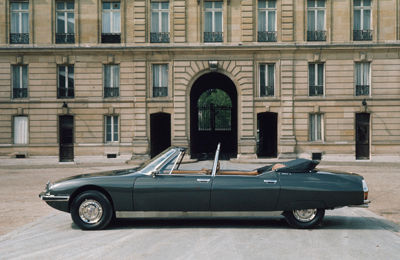
The decisive turning point came in 1968 when Citroën acquired Maserati. This marriage, which seemed improbable to some, was a strategic necessity: Citroën had the best suspension and aerodynamics in the world but lacked a noble engine. Under the leadership of engineer Giulio Alfieri, the Modena-based firm developed a compact and lightweight 90° V6, entirely made of aluminum, in record time. This engine block was essential to fit under the low-slung hood designed by the talented Robert Opron. He created a unique aerodynamic silhouette, featuring a glass rear hatch and a streamlined front end housing six headlights, achieving a remarkable Cx of 0.33. The SM was no longer just an improved DS; it became a manifesto of power and elegance.
A technological laboratory named SM: audacity for the future
When it was presented at the Geneva Motor Show in March 1970, the SM caused a sensation. Its name, combining the "S" from the initial project and the "M" for Maserati, clearly announced its intent. Beyond its futuristic aesthetics, it established itself as a technological showcase without equal on the market. Notably, it introduced DIRAVI (Power-Assisted Return Steering), a fully hydraulic steering system that hardened with speed and automatically returned to the center, even when stationary. This innovation, though surprising at first, allowed for unmatched driving precision at high speeds.
The SM did not stop there. It carried over the famous hydropneumatic suspension from the DS but optimized it for high-performance driving. For night safety, it featured six headlights under glass, with the inner lamps being directional and the entire lighting unit equipped with a dynamic leveling system. Regarding braking, Citroën opted for four disc brakes assisted by the high-pressure central hydraulic system, with the front discs mounted inboard to reduce unsprung weight. With its 2.7-liter V6 developing approximately 170 hp, the SM became the fastest front-wheel-drive car in the world, capable of reaching 220 km/h, all within a level of refinement that its direct competitors struggled to offer.
An exceptional career cut short by global crises
Between 1970 and 1972, the Citroën SM experienced its golden age. It became the icon of Pompidou’s France and was successfully exported, particularly to the United States, where it was named "Car of the Year" by Motor Trend magazine in 1972. Despite aesthetic modifications required by local regulations, approximately 2,400 units were sold there, attracting an intellectual and wealthy clientele. Unfortunately, 1973 marked a brutal halt. The first oil crisis caused fuel prices to soar and led to the introduction of speed limits. A grand touring coupe consuming between 12L and 18L per 100 km suddenly became politically incorrect.
In addition to this macroeconomic situation, internal difficulties arose. The Maserati engine, while brilliant, required rigorous and specialized maintenance. The Citroën dealer network, unaccustomed to the complexity of Italian mechanics, sometimes struggled to provide technical support, particularly regarding the timing chain. Production plummeted, dropping from over 4,000 units in 1972 to just 115 in 1975. The acquisition of Citroën by Peugeot in 1974 sealed the car's fate. The new management, focused on profitability, halted production after only 12,920 units. However, the SM remains a beloved collector's car today, owned by figures like Jay Leno or Johan Cruyff, and stands as a symbol of French excellence.
Conclusion: the destiny of a technological shooting star
In conclusion, it can easily be said that the SM was a crazy bet. Daring to market a Grand Touring car with a Maserati engine, priced at the time at 46,000 FF (roughly three times the price of a DS 21), required an audacity that only Citroën could possess. Although external circumstances and the brand's fragile financial situation turned this adventure into a short-lived career, the SM leaves an indelible mark on the automotive pantheon. It represents that period of total freedom where engineering and style triumphed over simple economic rationality. A crazy bet that, despite relative commercial failure, has transformed into an eternal legend.


Comments