

Citroën Méhari Azur: the story of the special series that became a legend

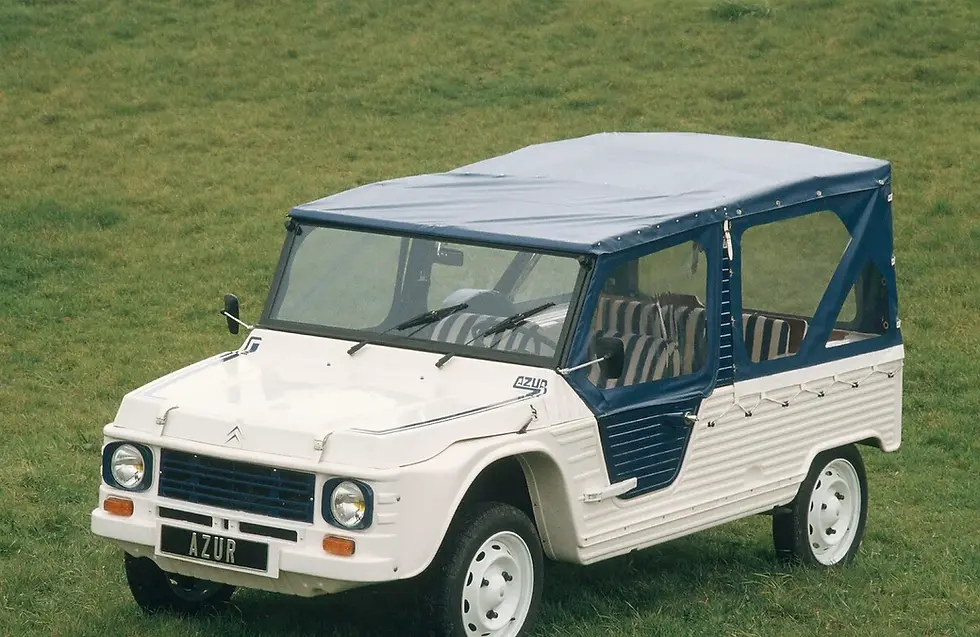
The Citroën Méhari perfectly embodies a certain idea of automotive freedom, combining a rugged ABS plastic design with unmatched versatility since its memorable launch in the spring of 1968. However, after fifteen years of a highly successful career across all terrains, the little chevron-branded adventurer began to show serious signs of age in the early 1980s. Facing a sharp commercial slowdown, the French carmaker decided to exploit a marketing formula it had mastered perfectly: launching a special series. Building on the resounding success of previous operations conducted on other popular models, the manufacturer designed a resolutely different Méhari, specifically styled to attract a new clientele. This unique version met with immediate popular success, turning the final moments of this historic model into a true aesthetic triumph.
A commercial decline marked by the weight of time: the automotive context of 1983
To fully understand the genesis of this summer icon, it is essential to look back at the economic and industrial context of the double-chevron brand at the turn of the 1980s. Launched in the direct wake of the May 1968 events, the Citroën Méhari had established itself as the ideal tool for farmers, police forces, and holidaymakers thanks to its lightweight bodywork and simple mechanics. However, the automotive market of 1983 was vastly different from that of the previous decade, and the weight of years was pressing heavily on the angular silhouette of the little beach car.
The production figures of this period clearly reflect the growing disaffection of the public for a concept that seemed to have run its course. In 1980, the assembly lines still managed to deliver a respectable volume of 8,351 units. This number suffered a sharp decline the following year, with production dropping to just 4,833 units in 1981, before sliding further to a critical threshold of 4,137 vehicles by the end of 1982. The collapse continued at an alarming rate during 1983, a period in which the factory recorded only 3,349 units leaving the workshops.
Faced with this continuous erosion of sales volumes, Citroën's commercial management had to react quickly to offer a proper send-off to its famous plastic adventurer. Within this specific strategic framework, the brand decided to develop two distinct special series to revitalize the car's playful image. While the Méhari Plage was developed primarily to support dealerships in Spain and Portugal, France and other European markets prepared to welcome a much more ambitious proposition named the Azur limited series. To optimize industrial costs at this end of the cycle, overall production of the model was transferred to the Portuguese plant in Mangualde, Portugal, a historic site tasked with the meticulous manufacturing of these final versions intended to revive the model's commercial dynamics.
Azure Blue and White: an aesthetic metamorphosis inspired by coastal resorts
The Citroën Méhari Azur instantly stood out from the rest of the automotive production of its time thanks to its fresh exterior and interior presentation, radically breaking away from the utilitarian or military hues that had previously dominated the model's history. Conceived as a tribute to the Riviera lifestyle, the ABS plastic bodywork featured an exclusive two-tone combination. The main body adopted an immaculate white that contrasted elegantly with a deep blue strategically applied to the side doors, the redesigned front grille, the central structural pillars, and the headlight surrounds. To perfect this unique visual identity, matching blue decorative stripes subtly adorned the hood. This color scheme was not chosen at random; it irresistibly evoked the world of sailing, pleasure yachts, and the sunny docks of the most prestigious French seaside resorts like Saint-Tropez, Deauville, or La Baule.
The modernization effort did not stop at paintwork, as the Azur also benefited from an entirely new blue canvas top. Inspired by the clever system equipping the famous 2CV Club, this roof offered improved modularity thanks to a partial opening feature located just above the front seats, transforming the cabin into a convivial convertible in moments. However, the most spectacular and memorable element of this special series was hidden inside: an upholstery that would instantly enter the brand's legend. The front seats and rear bench were entirely covered in a unique striped terry cloth fabric, a choice that immediately recalled vintage seaside lounge chairs, beach towels, and classic changing cabins. Visually refreshing, this unique upholstery significantly improved thermal comfort for passengers in direct sunlight.
To complete this exclusive package, the car received white openwork rims borrowed from newer Citroën models, modernizing the general silhouette. On a purely technical level, this version retained the proven mechanical architecture of the classic lineup, namely the valiant 602 cc air-cooled flat-twin engine developing 29 hp DIN. Paired with a four-speed manual gearbox driving the front wheels, this engine moved a featherweight mass of about 555 kg within a compact layout of 3.52 meters in length. While pure performance remained unchanged, the designers focused entirely on creating an unparalleled summer atmosphere.
From limited edition to mass production success: the exceptional destiny of a collector's item
Upon its official revelation in the spring of 1983, the Citroën Méhari Azur was initially presented as an edition strictly limited to just 700 units, a confidential release exclusively intended for three targeted European countries: France, Italy, and Portugal. However, the reception from the public and the dealer network immediately exceeded the marketing team's most optimistic forecasts. Faced with a massive influx of orders and enthusiasm that did not wane over the months, the brand made the historic decision to permanently integrate the Azur into its regular catalog, transforming what was meant to be a fleeting special edition into a permanent mass-production finish. This atypical commercial trajectory gives the Azur a distinct status in the brand's history, combining the charm of a special edition with the longevity of a standard model.
Today, this version is undisputedly among the most sought-after iterations by collectors worldwide, perfectly reproducing the popular and hedonistic image of the Méhari. This immense popularity, however, brings a downside to the classic car market. Due to the availability of numerous complete restoration kits allowing a standard version to be easily modified, the market is unfortunately filled with fake Azur variations created after the fact. For discerning buyers, authenticating an original period-certified example has become a crucial challenge, requiring a meticulous examination of chassis numbers, the compliance of plastic structure colors, and the presence of specific details essential for its historical traceability.
By successfully transitioning from a simple limited series to a full-fledged finish within the official catalog, the Citroën Méhari Azur established itself as the most famous and iconic variant in the long career of this unique beach car. A few clever stylistic adjustments and the introduction of an evocative color harmony were enough to unexpectedly revive the commercial career of this ABS plastic model, allowing it to continue its journey with elegance until the definitive end of its industrial manufacturing in 1986. In total, this extraordinary automotive epic resulted in the global production of over 144,000 units worldwide, leaving behind the imperishable memory of an Azur version that remains, even today, the absolute symbol of holidays, lightheartedness, and a certain French-style freedom.


Comments