

Citroën 2 CV Cocorico: the story of the tricolour limited edition celebrating its 40th anniversary


The history of the double chevron brand is punctuated by bold commercial animations that profoundly redefined how a popular automobile could be marketed. As the year 2026 marks a major symbolic milestone with the celebration of the fiftieth anniversary of the mythical 2 CV Spot—the very first genuine special series in Citroën's history, launched back in 1976—the memorial calendar highlights another equally remarkable anniversary.
Indeed, another emblematic variation of the famous "Tin Snail" is celebrating forty years of existence: the memorable 2 CV Cocorico. Perfectly embodying the graphic eccentricities of the 1980s, this eminently patriotic version captures the popular, inventive, and deeply French spirit of a manufacturer then undergoing a major identity shift. A historical review is essential to understand how a model originally designed to accompany an ephemeral sporting breakthrough managed to establish itself permanently in the hearts of collectors worldwide.
The context of a launch under the banner of football
To understand the genesis of the 2 CV Cocorico, one must plunge back into the electric atmosphere of 1986. The automotive and sporting worlds were about to vibrate in unison on the occasion of the Football World Cup organized in Mexico. At this pivotal period, the French national football team, led by an exceptional generation of players, stood out as one of the most formidable squads, generating unprecedented popular enthusiasm across the country. Seizing this wave of collective energy, Citroën's commercial management devised a major promotional campaign capable of linking the destiny of its most iconic car to the exploits of the national team.
The initial concept was based on a bold gamble: to design a limited edition intended to accompany, or even celebrate in anticipation, a global coronation for the French team. Unfortunately, sporting destiny decided otherwise. Despite a remarkable run marked by historic victories against Italy and Brazil, the French team suffered a painful defeat in the semi-finals against West Germany on June 25, 1986.
This event deeply altered the project's timeline and philosophy. Initially thought out to coincide with the effervescence of the tournament, the car underwent major conceptual adjustments to remove references that were too explicitly linked to football, such as the soccer ball patterns originally planned for the bodywork. It was ultimately at the beginning of October 1986, at the Paris Motor Show, that the 2 CV Cocorico was officially unveiled to the public. Produced in a run of just 1,000 units and strictly reserved for the French market, it began its commercial career in a post-World Cup climate tinged with nostalgia, turning what was meant to be a tool for sporting celebration into a timeless statement of French identity.
A tricolour coat dictated by the styling of Serge Gevin
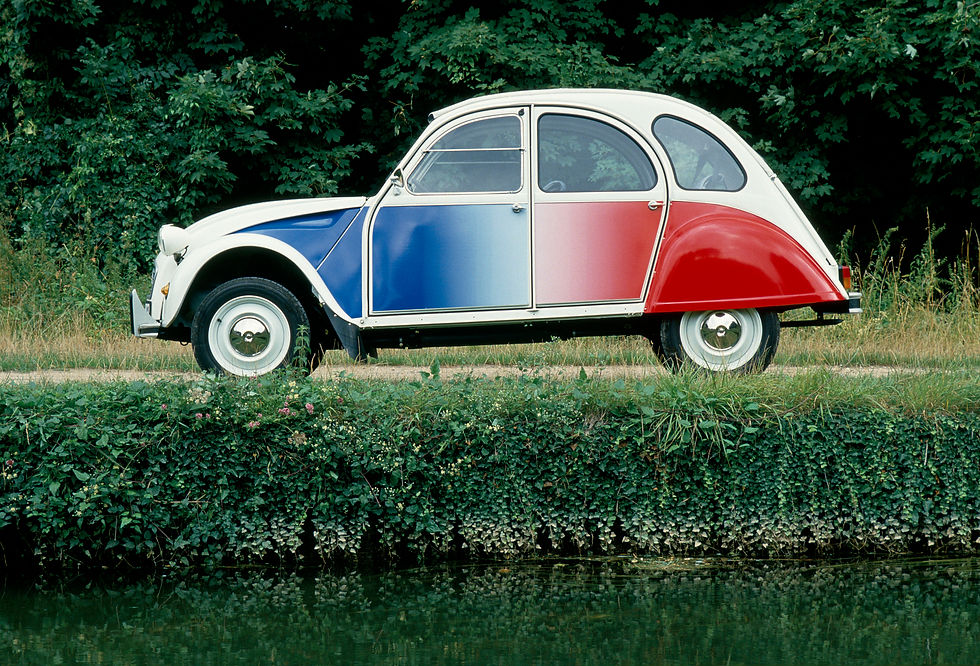
The design of the 2 CV Cocorico remains the work of the talented stylist Serge Gevin, who had already designed the Spot and the Charleston, signing here a particularly daring graphic composition. To serve as a base for this visual treatment, the creator selected the famous Blanc Meije white paint, a classic of the brand's color chart. It is on this immaculate bodywork that a unique styling treatment unfolds, characterized by a gradient of adhesive strips covering the flanks and doors of the vehicle. This graphic composition offers a fluid visual transition from blue to red, subtly framing the central white portion of the bodywork.
The exterior audacity did not stop there. To structure the silhouette and emphasize its unique character, the Cocorico features rear wings painted in Rouge Vallelunga red, while the side air vents on the bonnet are finished in an exclusive Bleu Cocorico blue. The upper section of the vehicle is equally distinctive, adopting a white cotton canvas roof that matches the color of the wheels, which are further enhanced by stainless steel hubcaps inherited from the Dyane 6. The specific monogram, applied in red adhesive lettering on the rear tailgate and near the front ventilation flap, completes this instantly recognizable visual identity.
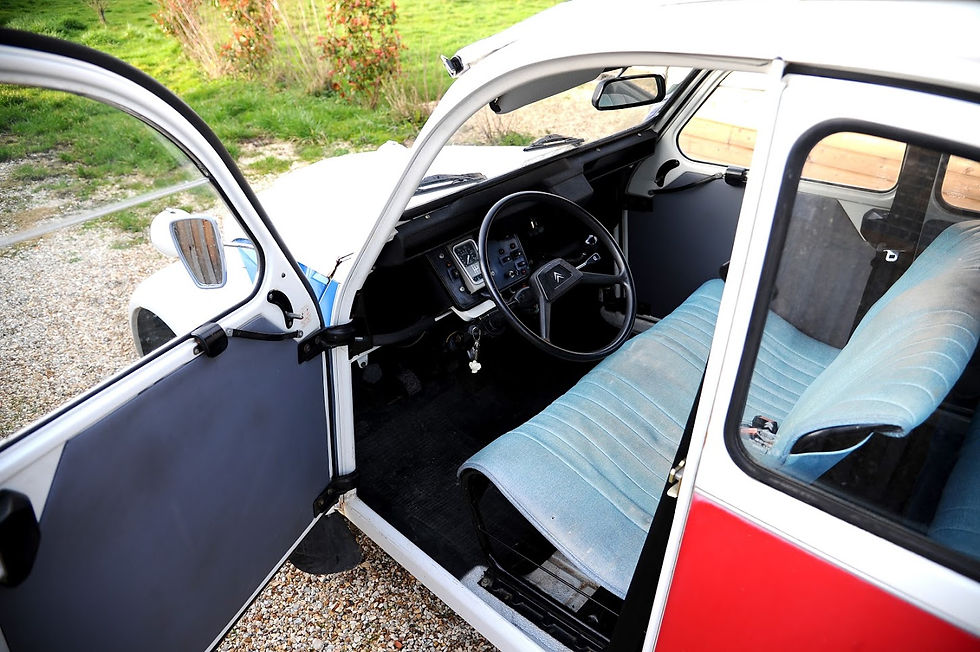
Inside the cabin, the distinction from standard production models is just as pronounced. While the 2 CV 6 Spécial from which it derives usually settles for a spartan simplicity, the Cocorico welcomes its occupants into an original and warm atmosphere. The two bench seats are fully upholstered in Bleu Sodalite simili Tep Jean. This choice of material, directly evoking the most popular textile of the era, gives the cabin a touch of casual modernity. This interior treatment, combined with the brightness offered by the white soft-top, allowed this version to stand out radically from contemporary automotive production.
From a shy welcome in dealerships to absolute iconic status
On a purely technical level, the Cocorico retains the proven architecture of the 2 CV 6 Spécial. Under its bonnet lies the brave 602 cm³ twin-cylinder engine developing 29 bhp DIN, mated to a four-speed manual gearbox. With a total weight of less than 600 kg, the vehicle preserves all the dynamic qualities that forged the model's legend, notably its legendary suspension comfort and fuel economy. Offered at the price of 36,100 Francs including tax, this limited edition remained in the catalog until March 1987.
Yet, despite these arguments, the 2 CV Cocorico did not trigger the commercial tidal wave initially hoped for by management. Its late arrival on the market, several months after the end of the World Cup in Mexico, combined with the elimination of the French team, deprived the model of the psychological boost essential to the dazzling success of such a themed car. For many customers of the time, displaying such ostensibly patriotic colors sometimes felt excessive for everyday driving, which explains why some examples spent long months in dealership yards before finding a buyer.
Time, however, has done its work and radically reversed these trends. While special series like the Charleston or the France 3 met with immediate public success, it is precisely the confidential distribution of the Cocorico that makes it so strong in today's collector market. Produced in only a thousand units—a large proportion of which have succumbed to the ravages of time, corrosion, or subsequent aesthetic modifications—it has risen to the rank of a true holy grail for Citroën enthusiasts. Its intrinsic rarity, coupled with the uniqueness of its history linked to the sporting emotions of a whole nation, ensures it a special and highly respected place in the glorious history of the double chevron brand.
Forty years after its official presentation under the glass roofs of the Grand Palais, the 2 CV Cocorico stands as one of the most fascinating emblems of the rich epic of limited-edition Citroëns. If its initial commercial career may have seemed timid, a collateral victim of the uncertainties of high-level sport, historical perspective has done it justice. It has successfully broken free from its purely footballing roots to become a timeless celebration of French culture and charm. By gradually conquering the hearts of the most demanding enthusiasts, this bi-colour version demonstrates that stylistic boldness and rarity always win out in the end. As the roads of 2026 resolutely turn toward new technological horizons, the Cocorico continues to project an invaluable part of our automotive heritage with an impertinent freshness.


Comments